Small steps now can make a big difference later
Supporting a child’s wellbeing can begin at any stage. Whether your child is young, becoming more independent, or already a teenager, there are things you can do that help build confidence, safety, respect, and resilience over time.
There is no perfect moment to start, and you do not need to have everything worked out. This page offers practical ideas to help you strengthen connection, open up conversations, and support your child to make safer, healthier choices as they grow.
You can explore the following areas:
- Gender Norms and Stereotypes
- Preventing Gender-Based Violence
- Preventing Sexual Harm
- Preventing Unhealthy Relationships
- Preventing Online Harm
If you are worried about any of these issues right now, you can learn more on our I’m Worried Now pages and find local and specialist support on our Get Support page.
If you want to explore any of these themes further with your child, our Tools for Talking page has conversation starters, guides, and activities to use with children and young people of all ages.
What are gender norms and stereotypes?
Gender norms are the unwritten rules about how boys and girls, and men and women, are expected to look, behave, feel, and relate to others. They are not laws, but they can feel just as powerful. They shape what children are praised for, what they are told to hide, what they believe is possible for them, and how they expect to be treated by others.
Gender stereotypes are the simplified ideas that grow from these norms: that boys should be tough and in control, that girls should be kind and accommodating, that showing emotion is weakness, that appearance defines worth. Most children absorb these messages long before they are old enough to question them.
These ideas come from everywhere: toys, media, sport, language, peer groups, online content, and the adults around them. They are so familiar they can be almost invisible. And because they are so familiar, they can feel harmless. They are not.
Why this matters more than it might seem
Rigid gender norms and stereotypes are not neutral. They shape how young people understand power, relationships, and what they are entitled to, with real consequences for how they treat others and how they expect to be treated.
The pyramid below helps explain why the everyday stuff matters as much as it does.
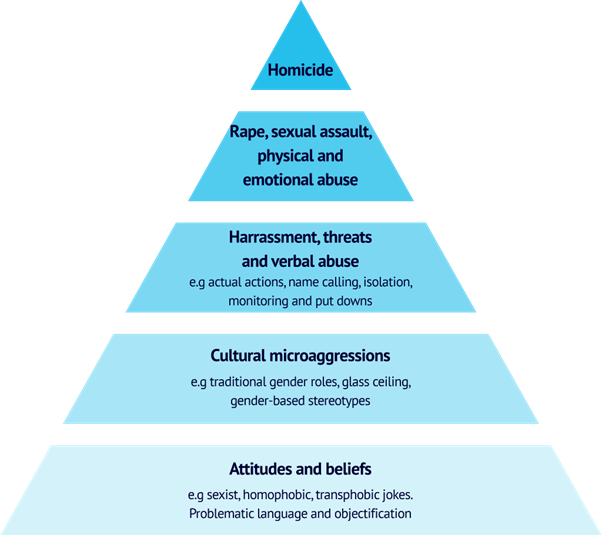
Remember, if you recognise that your child is displaying behaviours or attitudes described in the bottom layer of the pyramid, don’t be alarmed – it doesn’t necessarily mean that their behaviour will escalate to commit a serious crime. The key is to address low-level behaviours before they escalate, and we can help.
At the base of the pyramid are the attitudes, language, and behaviours that are so common they often go unchallenged: a joke dismissed as banter, a boy told to man up and stop crying, a girl praised for being quiet and agreeable, an online influencer who talks about women as inferior. These feel small. They are not.
The pyramid shows us that serious harm, controlling relationships, gender-based violence, and abuse, does not come from nowhere. It sits at the top of a much larger structure. And everything at the top is made possible by what sits beneath it.
The base of the pyramid is wide because these attitudes and behaviours are everywhere. The top is narrow because serious violence is less common. But without what sits at the base, the top cannot stand.
This is not about blame. Most people who repeat these messages have absorbed them without realising it, from their own upbringing, from the culture around them, from things they have laughed at or gone along with without thinking. Recognising the pattern is not the same as saying you are responsible for the harm at the top. It is about understanding that what happens at the bottom of the pyramid matters, and that challenging it, however small the moment feels, is one of the most important and powerful things a parent can do.
What this means for you
There are lots of small but meaningful ways you can prevent gender norms and stereotypes from escalating into worrying attitudes and behaviours, such as challenging a sexist comment at the dinner table, encouraging your child to name how they are feeling, or helping your child understand that their worth is not about how they look or how agreeable they are. None of these things feel like grand gestures, but that is precisely the point. Prevention happens in the everyday, in small, consistent moments that build understanding, confidence, and respect over time.
Everyday things you can do
- Question gender stereotypes when you encounter them, in advertising, toys, media, sport, or conversation
- Encourage children and young people to express emotions, not just manage or hide them
- Challenge language that limits what children can feel, do, or be based on their gender
- Praise children and young people for kindness, effort, curiosity, and courage, not just appearance or compliance
- Make space for questions about gender, identity, and fairness
- Model the kind of equality and respect you want your child to internalise
Talking with your child
You do not need to have a perfect explanation or all the answers. Conversations about gender norms work best when they are curious and ongoing, sparked by something your child has encountered rather than delivered as a lesson.
You might ask:
- ‘Why do you think boys and girls are expected to act differently?’
- ‘Is something fair just because it has always been that way?’
- ‘What do you think actually makes someone strong?’
- ‘What messages do young people get online about how they should look or act?’
- ‘What would it look like if everyone was treated equally?’
Helpful tools and resources
Our Tools for Talking page – has conversation starters and activities to help children think about gender, equality, and respect.
Visit our I’m Worried Now — Misogyny page – for guidance on responding when harmful gender attitudes are already showing up.
- Let Toys Be Toys – a campaign to challenge gendered toys and books and widen children’s ideas about who they can be
- The Fawcett Society — Gender Stereotypes report – research on how gender stereotypes limit children’s potential and cause lasting harm
What helps prevent gender-based violence?
Children begin learning about gender, power, fairness, and relationships from a very early age. They notice how people are spoken to, what behaviour is accepted or laughed off, and what messages they receive from the world around them, online and offline.
Helping children grow up with a strong sense of equality, empathy, and respect, and with the tools to understand their own feelings and others’, can significantly reduce the risk of harmful attitudes and behaviours developing later on.
Why this matters more than it might seem
Gender-based violence often grows from beliefs about entitlement, control, and inequality, beliefs that take root long before any serious harm occurs. As the pyramid above shows, prevention starts at the bottom: in everyday attitudes, language, and interactions.
The conversations you have with your child now, about feelings, fairness, and how people deserve to be treated, are the foundation of prevention. They do not need to be big conversations. They just need to be consistent.
Remember, if you recognise that your child is displaying behaviours or attitudes described in the bottom layer of the pyramid, don’t be alarmed – it doesn’t necessarily mean that their behaviour will escalate to commit a serious crime. The key is to address low-level behaviours before they escalate, and we can help.
Everyday things you can do
- Challenge sexist jokes or comments calmly and consistently
- Help children see that emotions, including sadness, fear, and vulnerability, are human, not gendered
- Reinforce that every child’s worth is about who they are, not how they look or how agreeable they are
- Model equal and respectful relationships in everyday life
- Talk about fairness and respect often, not just when something goes wrong
- Encourage children to speak up, take up space, and trust their instincts
- Help children question what they see, in media, online, and among peers
Talking with your child
Help them name and understand their feelings
One of the most powerful things you can do is help your child build emotional literacy, the ability to recognise, name, and express what they are feeling, rather than pushing feelings down or acting them out.
Children who can identify and articulate their emotions are better equipped to handle conflict, understand others, and build respectful relationships. Without this vocabulary, strong feelings often come out in ways that affect other people, sometimes seriously.
You might:
- Name emotions out loud yourself: ‘I felt a bit hurt when that happened’
- Ask feeling questions rather than just event questions: ‘How did that make you feel?’ as well as ‘What happened?’
- Validate feelings even when you are redirecting behaviour: ‘I can see you are really angry. It is okay to feel angry. It is not okay to shout at me.’
- Use books, films, or characters as a safe way in: ‘How do you think that character was feeling?’
- Help children see that naming feelings gives you more control, not less. It is a strength, not a vulnerability.
Help them understand consent and boundaries from an early age
Consent is not just a conversation for teenagers. It begins long before children are thinking about relationships in a romantic or sexual sense. Teaching children about bodily autonomy and personal boundaries from an early age gives them the language and confidence to understand their own limits and to respect others’.
This is not about making children fearful or distrustful. It is about helping them understand that their body belongs to them, that other people’s bodies belong to them, and that respect means asking and listening, not assuming.
You might:
- Let children decide how they show affection. Do not insist they hug or kiss relatives if they do not want to.
- Explain the why: ‘Your body belongs to you. You get to decide who touches it.’
- Model asking for consent in everyday moments: ‘Can I have a hug?’ rather than just reaching for one
- Help children understand that no means no, in games, in tickling, in play, and that when someone says stop, you stop immediately
- Talk about the difference between safe and unsafe touch in age-appropriate language
- As they get older, expand the conversation: ‘Consent means both people genuinely want to. Not just going along with something, not feeling pressured, but actually choosing it.’
Keep the conversation going
Talking to children about gender equality and respect does not need to be one big conversation. It grows through everyday moments: something on TV, a comment from a friend, a situation they have described from school. Small, consistent messages are more powerful than occasional big talks.
You might ask:
- ‘What do you think makes someone strong?’
- ‘Is something fair just because it is common or has always been that way?’
- ‘How do you know if someone is comfortable with something?’
- ‘What would you do if something felt wrong but you were not sure how to say it?’
- ‘What messages do young people get online about how they should look or behave?’
Helpful tools and resources
Our Tools for Talking page – has conversation starters and activities to explore gender equality and respect with children of all ages.
Visit our I’m Worried Now — Gender-Based Violence page – for guidance if you are concerned about something specific.
Visit our I’m Worried Now — Misogyny page – for guidance on responding to harmful gender attitudes.
Same Side — UN Women UK – a campaign to help parents and carers talk to boys and young men about gender equality and respectful relationships
www.gov.wales/sound a campaign for men that helps prevent misogyny by encouraging conversations around harmful behaviours.
Visit our Get Support page for organisations that can help you with gender-based violence and related issues.
What helps prevent sexual harm?
Preventing sexual harm begins long before children are old enough to talk about sex or relationships in adult terms. It starts with helping children understand their body, boundaries, privacy, empathy, and choice. As they grow older, these early lessons become the foundation for understanding consent, healthy relationships, and how to treat others safely and respectfully.
Children and young people are also influenced by what they see around them, online, through peers, in media, and in wider culture. Ongoing conversations with a trusted adult can help them make sense of these messages and build healthier attitudes over time.
Why this matters more than it might seem
Some harmful sexual behaviour develops when children or young people have not had clear guidance about boundaries, consent, emotional regulation, or what respectful relationships look like. They may also be affected by peer pressure, exposure to pornography, harmful online content, or messages that normalise pressure or entitlement.
Prevention is not about assuming a child will cause harm. It is about giving every child the knowledge, values, and emotional tools they need to relate safely to others and to recognise when something is not right. These conversations also help protect children from being harmed themselves.
Everyday things you can do
- Teach body autonomy from an early age: ‘your body belongs to you’
- Respect when children say no to touch, and explain why you are doing this
- Talk about privacy and personal space as normal, positive concepts
- Help children notice and consider others’ feelings in everyday situations
- Teach the habit of asking before borrowing, touching, or sharing, starting young
Talking with your child
These conversations do not need to happen all at once. Small, natural moments are often the best place to start, and starting early means the bigger conversations feel less sudden when they come.
With younger children, you might talk about:
- Private body parts and why they are private
- Saying yes or no to touch, and that both are okay
- Respecting other people’s space and bodies
- The difference between safe secrets and unsafe secrets
With older children or teenagers, you might explore:
- Consent and what it really means: freely given, informed, and ongoing
- Pressure in relationships, online and in person
- Sharing images or messages: what is okay and what is not
- How to recognise when something feels uncomfortable or unfair, and what to do
- The difference between healthy curiosity and harmful behaviour
You might ask:
- ‘How do you know if someone feels comfortable or uncomfortable?’
- ‘What does respect look like in a friendship or relationship?’
- ‘What would you do if someone felt pressured?’
- ‘What should happen when someone says no or changes their mind?’
Helpful tools and resources
Our Tools for Talking page – has age-appropriate conversation guides and activities on body safety, consent, and healthy relationships.
Visit our I’m Worried Now — Harmful Sexual Behaviour page – for guidance if you are already concerned about a young person’s behaviour.
- NSPCC PANTS — the Underwear Rule – a simple, age-appropriate tool for talking to younger children about body safety
Visit our Get Support page for specialist organisations that can help with harmful sexual behaviour, sexual abuse, and exploitation.
What helps prevent unhealthy relationships?
Healthy relationships are learned gradually through everyday life. Children and young people learn about love, trust, boundaries, conflict, communication, and respect from the relationships around them, at home, in friendships, at school, online, and in wider culture.
They notice how people speak to one another, how disagreements are handled, whether apologies happen, and whether everyone’s feelings matter. When children grow up experiencing connection, consistency, empathy, and healthy boundaries, they are more likely to build respectful relationships themselves as they get older.
Why this matters more than it might seem
Many unhealthy relationships do not begin with obvious harm. They can start with behaviours that are sometimes mistaken for care or affection: jealousy, constant contact, possessiveness, or trying to control what someone wears, who they see, or what they say.
Coercive control, a pattern of behaviour used to dominate and frighten another person, is a criminal offence. It often develops so gradually that it can be hard to recognise from inside the relationship. Young people who have not had guidance about what healthy relationships look like are more vulnerable to both experiencing and perpetrating these patterns.
Without guidance, young people may also absorb messages that normalise unhealthy dynamics: that jealousy means love, that persistence is romantic even after someone says no, that conflict should be won rather than worked through. Prevention means helping young people build a clear picture of what healthy, equal, and safe relationships actually look like, before they are in one.
Everyday things you can do
- Model respectful communication at home, including during disagreements
- Show that conflict can happen without cruelty, fear, or one person always winning
- Apologise and repair after conflict. Children learn this is possible by seeing it.
- Teach that everyone has the right to boundaries, privacy, and their own opinions
- Encourage confidence, self-worth, and independence in all children
- Help your child build healthy friendships as a foundation for later relationships
- Challenge messages that romanticise control, jealousy, or possessiveness
- Talk about what coercive control looks like. The signs are covered in detail on our I’m Worried Now — Coercive Control pages, which cover both the family context and young people’s own relationships.
Talking with your child
These conversations can and should begin long before dating starts, because the foundations of healthy relationships are built in childhood, through friendships, family life, and everyday interactions.
With younger children, you might talk about:
- What makes a good friend: kindness, listening, fairness, and being able to say sorry
- Taking turns, respecting personal space, and making things right after a disagreement
- The fact that friendships should make you feel good about yourself, not anxious or uncertain
With older children or teenagers, you might explore:
- What respect looks like in a dating relationship, and what it does not
- The difference between someone caring about you and someone controlling you
- Coercive control: what it is, how it starts, and why it can be hard to see
- Pressure, jealousy, and possessiveness, and why these are warning signs, not signs of love
- Consent, communication, and how relationships should feel: safe, equal, and valued
- Green flags and red flags: what to look for in any relationship
You might ask:
- ‘How should someone treat you if they care about you?’
- ‘What is the difference between checking in and checking up on someone?’
- ‘How would you know if a relationship felt unhealthy?’
- ‘What would you do if a friend was being pressured or controlled?’
- ‘If someone made you feel like you had to change who you are, what would that tell you?’
Helpful tools and resources
Our Tools for Talking page – has conversation starters and activities on healthy relationships, consent, and recognising unhealthy patterns.
Visit our I’m Worried Now — Coercive Control page – for guidance if coercive control is already a concern in your family.
Visit our I’m Worried Now — Relationships and Dating page – for more information on healthy and unhealthy relationships.
Visit our Get Support page for organisations that can help with relationships, domestic abuse, and coercive control.
What helps prevent online harm?
The online world is a normal part of growing up. Children and young people use digital spaces to learn, socialise, play, create, and explore who they are. Online life can bring real positives: connection, creativity, and access to information and communities they might not find locally.
At the same time, online spaces can expose young people to harmful content, peer pressure, bullying, exploitation, and unrealistic messages about relationships, gender, and identity. Preventing online harm is not about removing technology or monitoring everything your child does. It is about helping them build the confidence, judgement, and skills to navigate the online world safely, while knowing they can come to you if something goes wrong.
Why this matters more than it might seem
Many online harms happen quietly or build gradually over time. A child may not always recognise when something is unsafe, manipulative, or inappropriate, and may feel too embarrassed or worried about getting into trouble to ask for help.
Online experiences also shape behaviour offline. What young people see online can influence how they think about relationships, gender, bodies, conflict, and belonging. Without support, harmful messages or risky situations can become normalised. With the right conversations, young people learn to question what they see, trust their instincts, and make safer choices online and off.
Prevention also means helping children understand that their own online behaviour matters, including how they treat others, what they share, and how they respond to pressure from peers.
Everyday things you can do
- Keep regular, relaxed conversations about your child’s online life: who they talk to, what they enjoy, what they have seen
- Show genuine interest in the games, apps, and platforms they use
- Use parental controls and privacy settings where appropriate, and explain why
- Create family agreements around screen time, sharing, and respectful online behaviour
- Teach them how to block, mute, report, and leave unsafe situations online
- Help them think critically about influencers, trends, and content: who makes this, and why?
- Talk about privacy and what should never be shared online
- Reassure them regularly that they can come to you without fear of blame or punishment. This is the single most protective thing you can do
Talking with your child
These conversations work best when they are ongoing and low-pressure, woven into everyday life rather than saved for a single big talk.
With younger children, you might talk about:
- Asking before downloading apps or chatting with strangers online
- Keeping personal information private: name, school, address, photos
- Telling a trusted adult if something online feels upsetting, confusing, or wrong
- Being kind to others online, because the same rules apply as in real life
With older children or teenagers, you might explore:
- Pressure to share images or personal information, and how to say no
- Online relationships, grooming, and how trust can be built and exploited
- Sextortion: what it is, how it happens, and what to do
- Harmful influencers and extreme content: how to recognise and question it
- Cyberbullying and group chat behaviour, including being a bystander
- How online choices can have real-life consequences for themselves and others
You might ask:
- ‘What do you enjoy online at the moment? Show me.’
- ‘Has anything online ever made you feel uncomfortable or confused?’
- ‘What would you do if someone online asked for something private?’
- ‘How can you tell if someone online is not who they say they are?’
- ‘What does respectful behaviour look like online?’
- ‘If something went wrong online, what would you do? Who would you tell?’
Helpful tools and resources
Our Tools for Talking page – has resources and conversation guides to help children and young people navigate the online world safely and critically.
Visit our I’m Worried Now — Online Safety page – for guidance on specific online risks including grooming, sextortion, and harmful online influences.
- Internet Matters – practical guides for parents on a wide range of online safety issues, organised by age group
- Cyber Safety Guy – Free tools and guides for parents for the internet, apps, social media and gaming.
- CEOP Education — guidance for parents – from the Child Exploitation and Online Protection team, part of the National Crime Agency
- Childnet — talking to your child about online safety – resources and conversation guides for parents
- Mind Your Feed – A guide that helps parents and teens talk about how social media algorithms influence what they see
Visit our Get Support page for specialist organisations covering online safety, sextortion, grooming, and exploitation.